SimBi Quickstart

Installing and Importing
First we install SimBi with pip
[ ]:
!pip install simbi
Now let’s install some other Python packages which we’ll need.
[29]:
import numpy as np
import matplotlib.pyplot as plt
from scipy.constants import physical_constants
import simbi
Thermal Cloud
We start with simulating a thermal cloud. First, let’s define the physics quantities we need starting with the harmonic trap frequencies.
[30]:
wx = 2 * np.pi * 350
wy = 2 * np.pi * 300
wz = 2 * np.pi * 30
trap_freqs = (wx, wy, wz)
Now we let’s define the mass, time-of-flight, the temperature and the chemical potential \(\mu\). These are all given in SI units.
[31]:
amu = physical_constants['atomic mass constant'][0]
m = 87 * amu
t = 0.001
T = 200e-09
mu = 7e-31
Next, we want to define a series of coordinates to calculate the densities. However, we first get the length scales of the thermal cloud after time-of-flight
[32]:
_, t_sigmas = simbi.get_sigmas(trap_freqs, m, T, mu, t)
We now get coordinate maps for one, two and three dimensions which correspond to the three trapping axes. Furthermore, this built in function also gets the differential elements for each axis, which we can use for numeric integration.
[33]:
coords_base, coord_maps, diff_elements, clength = simbi.get_coordinates(t_sigmas, 6, multi=True)
xcoords, ycoords, zcoords = coords_base
coords_3d, coords_2d, coords_1d = coord_maps
dv, da, dx = diff_elements
Although we used a built-in function to get these coordinate maps you can easily use np.meshgrid to create your own. Next, we calculate the full 3D density. Furthermore, we calculate the 2D and 1D densities. For the 2D density the full 3D density has been integrated along the z-axis, whereas for the 1D density the density has been integrated along both the x and z axes.
[34]:
from simbi import thermal_density

density_3d = simbi.thermal_density(coords_3d, trap_freqs, m, T, -mu, t)
density_2d = simbi.thermal_density(coords_2d, trap_freqs, m, T, -mu, t)
density_1d = simbi.thermal_density(coords_1d, trap_freqs, m, T, -mu, t)
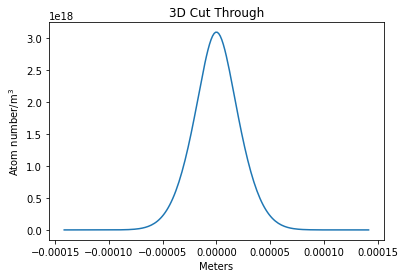
Now let’s plot a cut-through of the 3D density distribution
[35]:
plt.figure()
plt.plot(zcoords, density_3d[int(clength/2), int(clength/2)])
plt.ylabel('Atom number/m$^3$')
plt.xlabel('Meters')
plt.title('3D Cut Through')
[35]:
Text(0.5, 1.0, '3D Cut Through')
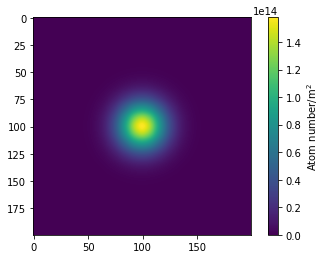
Now the 2D density
[36]:
plt.figure()
plt.imshow(density_2d)
plt.pcolormesh(*coords_2d, density_2d)
plt.colorbar(label='Atom number/m$^2$')
plt.show()
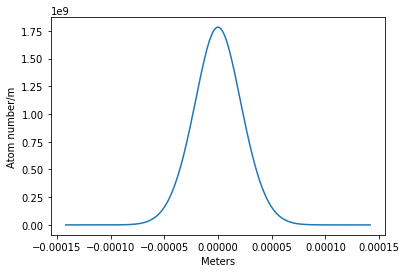
And finally the integrated 1D density
[37]:
plt.figure()
plt.plot(zcoords, density_1d)
plt.ylabel('Atom number/m')
plt.xlabel('Meters')
[37]:
Text(0.5, 0, 'Meters')
Finally, we can analytically calculate the total number of atoms
[38]:
simbi.thermal_atom_number(trap_freqs, -mu, T)
[38]:
20188.357732472745
Thermal Cloud
Now we can simulate the BEC. We use the same simulation values as above, but additionally include the scattering length \(a_s\)
[39]:
a0 = physical_constants['Bohr radius'][0]
a = 100 * a0
We want the coordinate grid to match the BEC and so we first calculate the length scales of the BEC at some expansions time \(t\) and then get the coordinate maps.
[40]:
_, _, tf_radii = simbi.get_radii(trap_freqs, m, a, mu, t)
_, coord_maps, diff_elements, clength = simbi.get_coordinates(tf_radii, 2, multi=True)
coords_3d, coords_2d, coords_1d = coord_maps
dv, da, dx = diff_elements
We can now calculate the fulll 3d density, the integrated 2d density and the integrated 1d density (see thermal section for more details).
[41]:
from simbi.bec import bec_density
density_3d = bec_density(coords_3d, trap_freqs, m, a, mu, t)
int_density_2d = bec_density(coords_2d, trap_freqs, m, a, mu, t)
int_density_1d = bec_density(coords_1d, trap_freqs, m, a, mu, t)
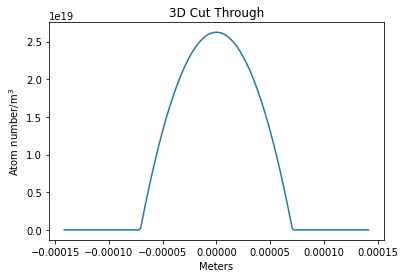
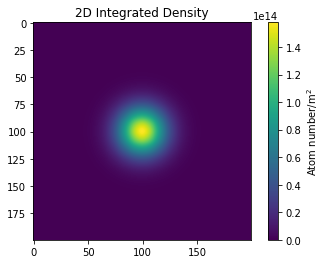
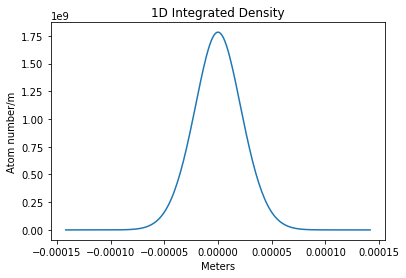
And similar to the thermal cloud we can plot these all out
[42]:
plt.figure()
plt.plot(zcoords, density_3d[int(clength/2), int(clength/2)])
plt.ylabel('Atom number/m$^3$')
plt.xlabel('Meters')
plt.title('3D Cut Through')

plt.figure()
plt.imshow(density_2d)
plt.pcolormesh(*coords_2d, density_2d)
plt.colorbar(label='Atom number/m$^2$')
plt.title('2D Integrated Density')
plt.show()

plt.figure()
plt.plot(zcoords, density_1d)
plt.ylabel('Atom number/m')
plt.title('1D Integrated Density')
plt.xlabel('Meters')
[42]:
Text(0.5, 0, 'Meters')
Now we calculate the BEC atom number.
[48]:
simbi.bec_atom_number(trap_freqs, m, a, mu)
[48]:
8845.879949750666
Bimodal Cloud
Often, we wish to simulate a bimodal distribution featuring both a thermal cloud and a BEC. Once again, we need to get the length scales to properly calculate our coordinate maps. This time we return all the length scales, both in-trap and at time-of-flight
[49]:
all_radii = simbi.bimodal_radii(trap_freqs, m, T, a, mu, t)
init_sigmas, t_sigmas, init_tf_radii, expans_scalars, tf_radii = all_radii
---------------------------------------------------------------------------
AttributeError                            Traceback (most recent call last)
~\AppData\Local\Temp\ipykernel_17160\111765678.py in <cell line: 1>()
----> 1 all_radii = simbi.bimodal_radii(trap_freqs, m, T, a, mu, t)
      2 init_sigmas, t_sigmas, init_tf_radii, expans_scalars, tf_radii = all_radii

AttributeError: module 'simbi' has no attribute 'bimodal_radii'
We once again use the thermal cloud’s length scales as it is larger than the BEC.
[50]:
(x,y,z), coord_maps, diff_elements, clength = simbi.get_coordinates(t_sigmas, 6, multi=True)
coords_3d, coords_2d, coords_1d = coord_maps
dv, da, dx = diff_elements
Now we calculate the bimodal densities
[51]:
densities_3d = simbi.bimodal_density(coords_3d, trap_freqs, m, T, a, mu, t)
densities_2d = simbi.bimodal_density(coords_2d, trap_freqs, m, T, a, mu, t)
densities_1d = simbi.bimodal_density(coords_1d, trap_freqs, m, T, a, mu, t)
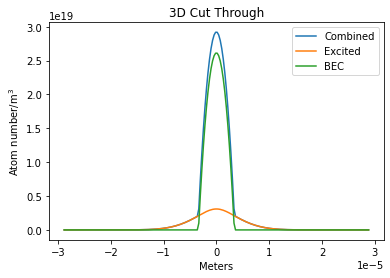
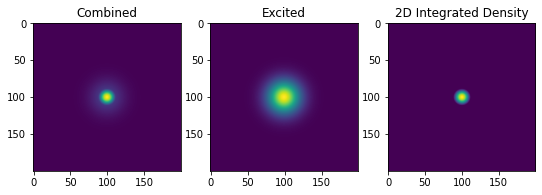
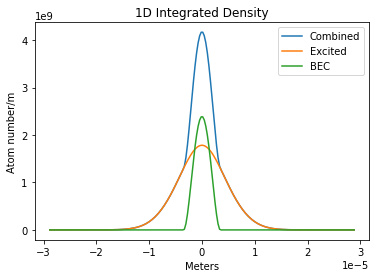
Finally, we plot the bimodal distributions
[52]:
plabels = ['Combined', 'Excited', 'BEC']
slicev = int(clength / 2)

plt.figure()
plt.title('3D Cut-through')
for label, density in zip(plabels, densities_3d):
    plt.plot(x, density[slicev, slicev], label=label)
plt.ylabel('Atom number/m$^3$')
plt.xlabel('Meters')
plt.title('3D Cut Through')
plt.legend()
plt.show()

fig, axes = plt.subplots(1, 3, figsize=(9, 3))
for ax, label, density in zip(axes, plabels, densities_2d):
    ax.imshow(density)
    ax.set_title(label)
# plt.colorbar(label='Atom number/m$^2$')
plt.title('2D Integrated Density')

plt.figure()
plt.title('1D Integrated')
for label, density in zip(plabels, densities_1d):
    plt.plot(x, density, label=label)
plt.ylabel('Atom number/m')
plt.title('1D Integrated Density')
plt.xlabel('Meters')
plt.legend()
[52]:
<matplotlib.legend.Legend at 0x13ca5e9d1c0>
Now we calculate all the atom numbers and the condensed fraction.
[53]:
atom_numbers = simbi.bimodal_atom_numbers(trap_freqs, m, T, a, mu)

plabels = ['Combined', 'Thermal', 'BEC', 'Condensed Fraction']

for num, plabel in zip(atom_numbers, plabels):
    print(f'{plabel}: {num}')
Combined: 29034.23768222341
Thermal: 20188.357732472745
BEC: 8845.879949750666
Condensed Fraction: 0.3046706459652175
[ ]: